Experiment with impact hammer
This example presents the force reconstruction from an experiment with an instrumented hammer impacting a steel plate. The impacting force from the hammer is reconstructed from the kinematic fields measured by deflectometry.
Due to the large size of the dataset, the data is hosted on https://dataverse.no/ and can either be downloaded manually or using this toolkit.
Let’s now go through the necessary steps for force reconstruction based on deflectometry. First, we need to import the Recolo toolkit:
import recolo
The experimental data is conveniently downloaded and accessed via the ImpactHammerExperiment class:
exp_data = recolo.demoData.ImpactHammer()
After the download has completed, the force measurements can be accessed as:
hammer_force, hammer_time = exp_data.hammer_data()
The experiment was performed on a 300 mm x 300 mm rectangular plate with the following properties:
mat_E = 190.e9  # Young's modulus [Pa]
mat_nu = 0.3  # Poisson's ratio []
density = 7934
plate_thick = 4.95e-3
The stiffness of the plate is calculated as:
plate = recolo.make_plate(mat_E, mat_nu, density, plate_thick)
The experimental configuration is given by:
grid_pitch = 7.0  # pixels
grid_pitch_len = 2.5 / 1000.  # m
mirror_grid_distance = 1.63  # m
pixel_size_on_mirror = grid_pitch_len / grid_pitch * 0.5
We now set the pressure reconstruction window size:
win_size = 30
as well as filter and downsampling settings:
downsampling_factor = 5
filter_time_sigma = 6
filter_space_sigma = 2
The grid images are used as input to deflectomerty and the slope fields of the plate are determined:
slopes_y, slopes_x = recolo.deflectomerty.slopes_from_images(exp_data.path_to_data_folder, grid_pitch,
                                                         mirror_grid_distance, pixel_size_on_grid_plane,
                                                         ref_img_ids=ref_img_ids,
                                                         only_img_ids=use_imgs,
                                                         crop=(76, -35, 10, -10), window="triangular",
                                                         correct_phase=False)
The slope fields are then integrated to determine the deflection fields:
# Integrate slopes to get deflection fields
disp_fields = recolo.slope_integration.disp_from_slopes(slopes_x, slopes_y, pixel_size,
                                                       zero_at="bottom corners", zero_at_size=5,
                                                       extrapolate_edge=0, downsample=downsampling_factor)
Based on these fields, the kinematic fields (slopes and curvatures) are calculated:
kin_fields = recolo.kinematic_fields_from_deflections(disp_fields, downsampling_factor * pixel_size_on_mirror, sampling_rate,
                                                  filter_time_sigma=filter_time_sigma)
Now, the pressure reconstuction can be initiated. First we define the Hermite16 virtual fields:
virtual_field = recolo.virtual_fields.Hermite16(win_size, pixel_size_on_mirror)
and initialize the pressure reconstruction:
times = []
presses = []

for i, field in enumerate(kin_fields):
     recon_press = recolo.solver_VFM.calc_pressure_thin_elastic_plate(field, plate, virtual_field)
     presses.append(recon_press)
     times.append(field.time)

presses = np.array(presses)
The results can then be visualized:
center = int(presses.shape[1] / 2)

# Plot the results
plt.figure(figsize=(7,5))
plt.plot(times, np.sum(presses, axis=(1, 2)) * ((pixel_size_on_mirror * downsampling_factor) ** 2.), label="VFM force from whole plate")
plt.plot(times, np.sum(presses[:,20:50,20:50], axis=(1, 2)) * ((pixel_size_on_mirror * downsampling_factor) ** 2.), label="VFM force from subsection of plate")
plt.plot(hammer_time, hammer_force, label="Impact hammer")
plt.xlim(left=0.0008, right=0.003)
plt.ylim(top=500, bottom=-100)
plt.xlabel("Time [ms]")
plt.ylabel(r"Force [N]")

plt.legend(frameon=False)
plt.tight_layout()
plt.show()
The resulting plot looks like this:
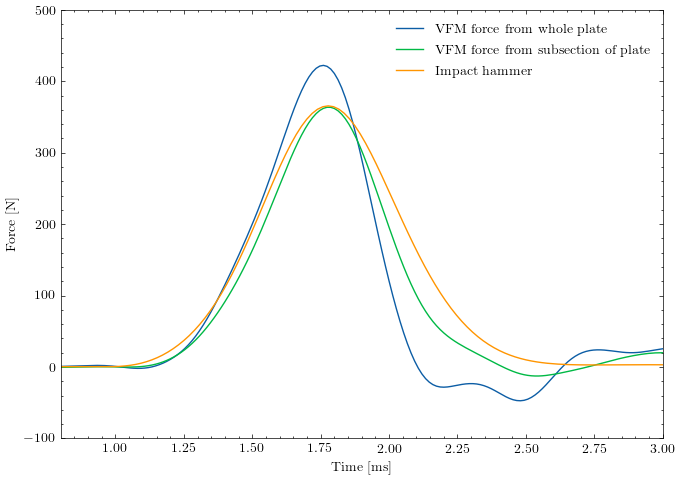
- A few things should be noted:
The force level is highly sensitive to the area over which the pressure is integrated.
The deviations are believed to be caused by interaction between deflection at the position of the hammer and the boundary conditions.
Filtering influences the force amplitude, but relatively large filter kernels can be used without decreasing the force level.